

Testing XSL
file://e:\websites\public\12571880\12571880_OttawaPoliceService\en\rotatingimages\rotatingImageData.xml
defaultInterior


Running towards danger: Cst Hanniman and Det Nissan’s heroic actions during Lisbon funicular crash
 Back to Search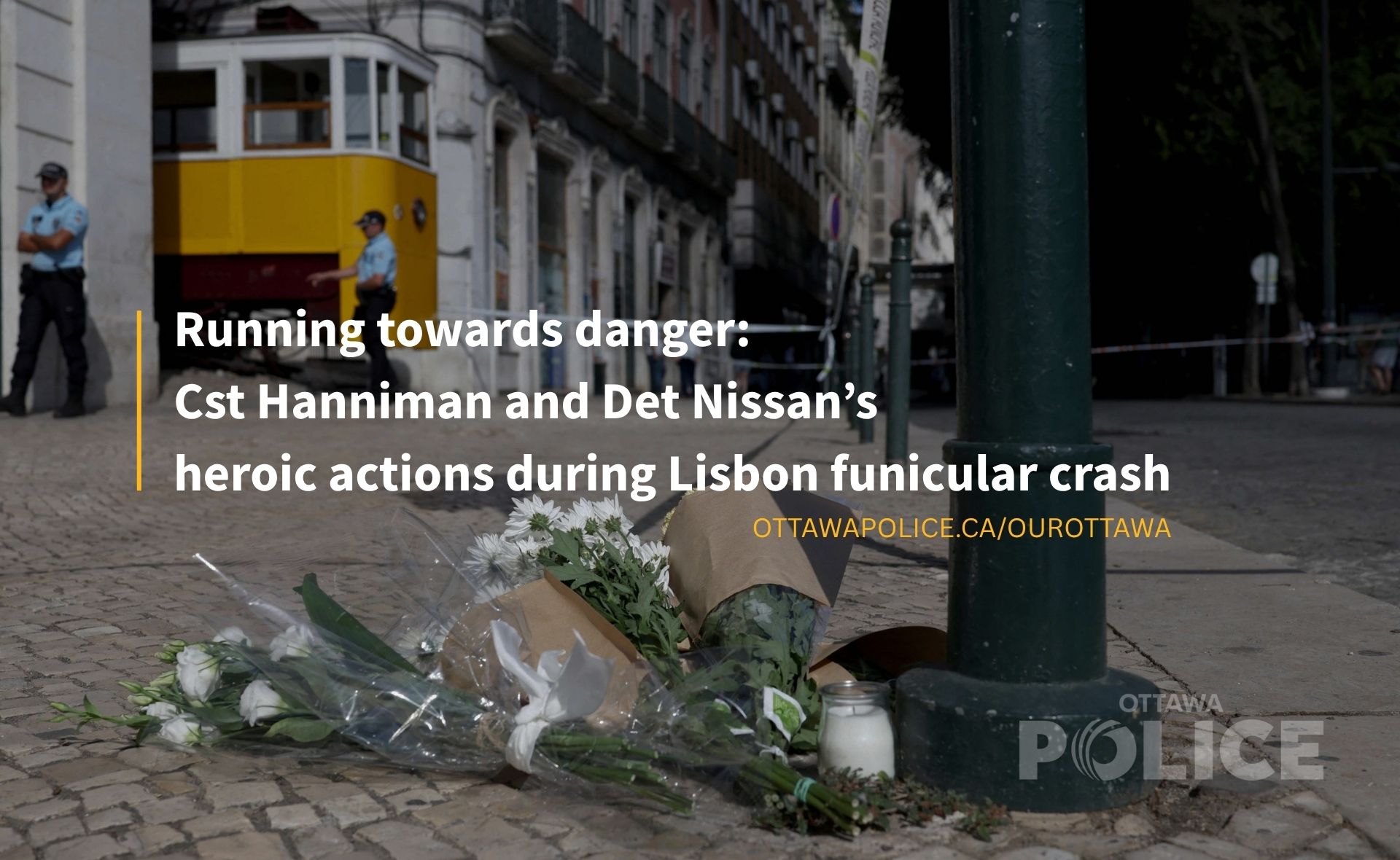
Trigger warning: This story contains discussion of a mass casualty event and graphic descriptions of injuries, which may be distressing for some readers.
September 3, 2025, was meant to be a vacation.
Constable Victoria Hanniman and Detective Marie Nissan were thousands of kilometres from home, exploring Lisbon, Portugal, enjoying a break from work. The two Ottawa Police officers stood at the base of one of the city’s historic hills, preparing to rent a scooter, when in an instant, their vacation turned into a rescue mission.
Above them, two of Lisbon’s iconic funicular cars traveled side by side up the steep incline, packed with tourists, families, and commuters.
Then came the sound.
A violent crash shattered the afternoon calm as one of the cars—the one at the bottom of the hill—suddenly jolted and slammed into the lower barrier. Metal screamed against metal. Panic erupted.
Without hesitation, Constable Hanniman and Detective Nissan ran toward the tram.
Off duty. Unarmed. Without radios, protective equipment, or any certainty about what had just happened, both officers immediately began helping terrified passengers escape. Hanniman moved quickly to assist people getting out of the unstable car, while Nissan moved toward the jammed main door, attempting to force it open.
“People began passing their children through the window to Victoria,” Det. Nissan explained. “I was trying to get the door to open, and once the door opened I started helping elderly people out.”
Then, a second explosion echoed from further up the hill.
“The world froze,” she said. “I could hear Victoria at the bottom of the hill screaming my name.”
Cst. Hanniman tried to get Det. Nissan’s attention. “I realized [after the sound of the explosion] that there was a second tram on the way down,” Cst. Hanniman recalled. “Because the one we were helping people out of was at the very bottom, so I knew the second tram was falling from the very top.”
Dust and smoke rolled down the tracks as screams filled the narrow streets. People began running downhill in terror. For a brief moment, both officers moved with the crowd long enough to avoid being trampled or crushed by the funicular crashing down.
“I saw the second cart coming and I ran for my life,” Nissan said.
Injured civilians were collapsing on the sidewalks. Some were conscious and screaming. Others lay motionless. It was immediately clear this was not over. This was the beginning of a mass casualty event that would impact many lives.
While crowds continued fleeing downhill, Constable Hanniman and Detective Nissan made a conscious decision that would define the next several minutes.
“Victoria and I looked at each other and said: we have to go up," Det. Nissan said. They stopped running, turned around, and ran back uphill toward the scene.
“I knew the moment I turned the corner when the air started to clear…” Cst. Hanniman recalls. “This was going to be the worst thing I ever experienced.”
As two female officers alone in a foreign country, facing language barriers, cultural differences, and the very real possibility of electrical hazards, structural collapse, or another runaway tram, both officers knowingly placed themselves back in harm’s way to help others.
As they reached the bend in the tracks, the full scale of the catastrophe came into view.
The second funicular had derailed, tipped onto its side, and slammed violently into a nearby building, sweeping across the adjacent sidewalk and striking pedestrians. Twisted steel, shattered windows, exposed wires, debris, and dust covered the scene.
Inside the wreckage, victims were piled on top of one another. Many had already died.
There was a real risk that the funicular could come loose again and shoot down the track, that electrical systems could cause a fire, or that the structure could collapse further. But that did not stop them from moving through the wreckage.
“I lifted a piece of the cart connected to electrical wires and discovered a woman laying on her back with her face covered in blood,” described Nissan. “She was still alive.”
“I’m not sure what language she spoke, but she began to talk and pointed at her legs which were cut below the knees as it appeared that a large metal object—we think was the tram door—had sliced them through the bone.”
At that moment, their leadership became critical to managing the unfolding crisis.
Despite being a junior officer, Hanniman immediately stepped forward and took control of the chaotic scene. Alongside Detective Nissan, she began directing bystanders, many of whom stood frozen in shock, filming, or unwilling to approach the unstable wreckage.
In an environment where two women giving urgent commands were not immediately met with compliance, both officers had to raise their voices, repeat instructions, remain calm and assert authority through overwhelming fear. Hanniman and Nissan’s commanding presence broke through the paralysis, and under their direction, bystanders moved in.
Together, they coordinated these bystanders to lift the heavy metal off the injured woman and carry her out to save her from being crushed to death.
“I remember telling her she was going to be ok,” Cst. Hanniman recalls. “After sitting her down, she looked at me with the biggest smile and nodded—she was going to be okay. We didn’t speak the same language, but I understood everything she said and I felt instantly calm.”
While Detective Nissan continued coordinating civilians and assessing victims, Cst. Hanniman moved through the scene, checking for signs of life, identifying those who needed immediate extraction, navigating potentially fatal hazards, broken glass, more live wires and the emotional weight of multiple fatalities.
Both officers continued triaging victims and organizing civilians until emergency responders arrived. When local authorities reached the scene, Hanniman and Nissan provided a structured handover—identifying victims who had been removed, those who remained trapped, and those requiring immediate medical intervention. Only once emergency personnel assumed command did the two officers step back.
“The hardest part was walking away and feeling helpless once the emergency responders showed up,” Nissan explained.
Later, authorities confirmed the devastating toll: 16 people had been killed, 21 others were injured. Among them were Canadian tourists.
Portugal’s Air and Rail Accident Investigations Bureau determined that a broken underground cable, which acted as a counterweight between two carriages and caused the crash, was defective and never certified for passenger use.
Constable Victoria Hanniman and Detective Marie Nissan did what police officers do best. When everyone else ran away from danger to safety, they ran toward it to help.
Almost exactly eight months later, on May 1, 2026, Constable Victoria Hanniman was presented with the Ontario Women in Law Enforcement (OWLE) Award for Bravery, a recognition born from the heartfelt nomination submitted by Detective Marie Nissan—her friend, colleague, and the officer who stood beside her during the devastating mass casualty event in Lisbon.
From the audience, surrounded by hundreds of policing professionals from across Ontario, Det. Nissan proudly cheered as Hanniman walked to the stage, received her award and a standing ovation for her bravery.
Nissan, equally deserving of the same recognition for her own courage that day, was not focused on herself. Instead, she was determined to ensure Cst. Hanniman’s extraordinary courage, leadership, and selfless actions in the face of unimaginable danger were seen, honoured, and never forgotten. 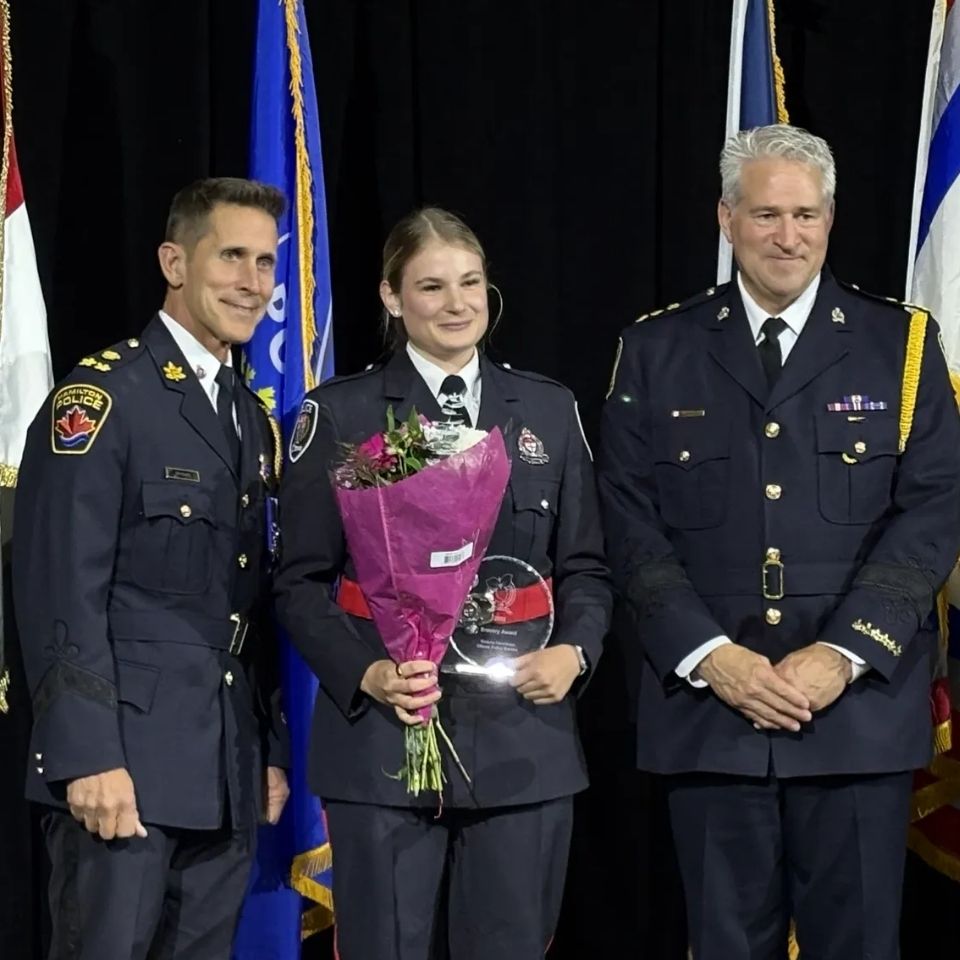
Before the tragedy happened, Nissan and Hanniman were simply two colleagues and friends on vacation trying to rent a scooter. “I was trying to scan the QR code and it was not working for some reason,” Nissan said. “Victoria was figuring out the route back to the Airbnb and Google Maps said to go up that same route where the crash occurred seconds later.”
Det. Nissan had an uneasy feeling imagining herself on the scooter up the steep hill along the narrow pedestrian pathway beside the trams. That moment of hesitation may have ended up saving both of their lives.
“We truly believe we were there for a reason and something was watching over us,” she said. “Because if we had gone up, or if that cart had not hit that building, we would not be here today.”